
These examples apply the same eventsurvey workflow to
two published studies. They are package reanalyses, not reproductions of
every model in the original articles. Each report contains estimates,
diagnostics, figures, survey coverage, and analysis settings.
To preserve the established application-specific estimands, these reports explicitly include the event period in the window-average estimate while suppressing its day-specific result. This differs from the package’s safer default for new analyses, which excludes the event period when within-period exposure is unclear.
All analyses use estimand-specific calibration. Daily bounds use matching elapsed forecast horizons. Period-average effects and bias bounds aggregate daily quantities after calibration. Average honest intervals use Bonferroni-adjusted daily intervals before aggregation; the displayed daily intervals are pointwise. The average standard errors include cross-day covariance. Validity requires the daily population bias restrictions.
Example reports
| Example | Event and outcome | Report |
|---|---|---|
| Bateson and Weintraub (2022) | 2016 U.S. election; trust in the U.S. government | Full analysis report |
| Epifanio, Giani, and Ivandic (2023) | 2005 London bombings; privacy- and procedural-rights restrictions | Full analysis report |
Compare average effects
The table shows estimates and 95% honest intervals regenerated with version 0.4.1, using the same estimator as release 0.4.0. It contains analytical results only, not respondent records or input period summaries. Reference windows are counted separately for each outcome.
| Outcome | Average effect | 95% honest CI | Reference windows |
|---|---|---|---|
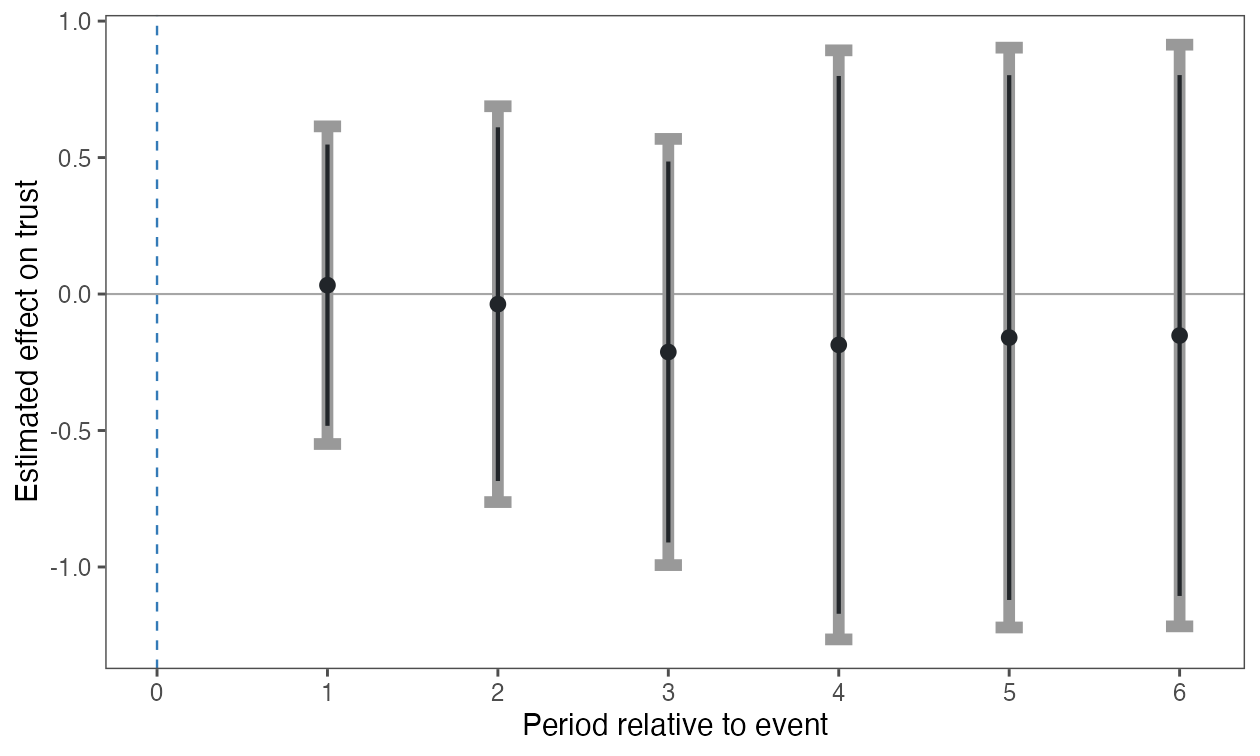
| Bateson: trust | -0.109 | [-1.147, 0.929] | 13 |
| Epifanio: privacy rights | -0.150 | [-1.438, 1.137] | 6 |
| Epifanio: procedural rights | -0.091 | [-1.222, 1.042] | 4 |
The reports identify each target period and show its daily results.
Bateson and Weintraub (2022)
This report presents a seven-period analysis. AmericasBarometer data cannot be redistributed, so the package includes no respondent records or daily summaries. Authorized users can obtain the data from LAPOP/CGD and regenerate the report locally.
Epifanio, Giani, and Ivandic (2023)
This report presents separately estimated privacy- and procedural-rights outcomes with estimand-specific calibration. The package includes the period-level sufficient statistics used in these analyses. Missing survey dates remain unobserved and are not interpolated.
Reproduce the reports
The rendering scripts regenerate both self-contained HTML reports, the estimate-only comparison table, and the figures above. Each report contains both methods with the main analyses first. The Bateson analysis requires an authorized local source file.
Sys.setenv(EVENTSURVEY_BATESON_DATA = "/path/to/cleaned_main.csv")
source("data-raw/render-application-reports.R")
source("data-raw/render-bateson-figures-local.R")
References
Bateson, Regina, and Michael Weintraub. 2022. “The 2016 Election and America’s Standing Abroad: Quasi-experimental Evidence of a Trump Effect.” Journal of Politics 84(4): 2300–2304. Article · Replication materials
Epifanio, Mariaelisa, Marco Giani, and Ria Ivandic. 2023. “Wait and See? Public Opinion Dynamics after Terrorist Attacks.” Journal of Politics 85(3): 843–859. Article · Replication materials
Also see
- Getting Started to fit the package’s bundled sample data and create a report.
- Reading an HTML Report to interpret the estimates, diagnostics, and figures in these examples.
- Estimating from Period-Level Summary Data for analyses like the Epifanio–Giani–Ivandic example when respondent records cannot be distributed.
- Complete Example Workflow for an end-to-end simulated analysis with sensitivity checks.